String Pieced Wall Hanging
Complete Step-by-Step Tutorial
What Is String Piecing?
String Piecing is a quilting technique where narrow strips of fabric, called strings, are sewn together to create a new piece of fabric.
Unlike traditional patchwork, the strips do not have to be the same width.
The beauty of string piecing comes from mixing:
- leftover scraps
- different prints
- different colors
- different widths
The finished fabric is then cut into blocks or panels.
Quilting Vocabulary
| Term | Definition |
|---|---|
| String | A narrow strip of fabric, usually less than 2½” wide. |
| String Piecing | Sewing narrow strips together to create new fabric. |
| Foundation Piecing | Sewing fabric onto a foundation for stability. |
| Foundation | The base fabric or paper used while sewing. |
| Bias Edge | A cut made at a 45° angle to the grain of the fabric. |
| Quilt-As-You-Go | Quilting each section individually before joining. |
| Wall Hanging | A quilt intended for display on a wall. |
| Panel | A long rectangular section of the quilt. |
| Hanging Sleeve | A fabric tube sewn to the back for hanging. |
| Quilt Label | Information sewn onto the back of the quilt. |
Finished Project
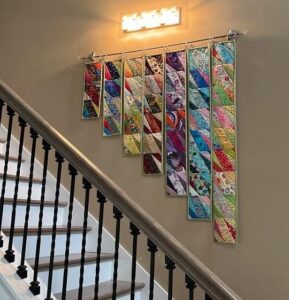
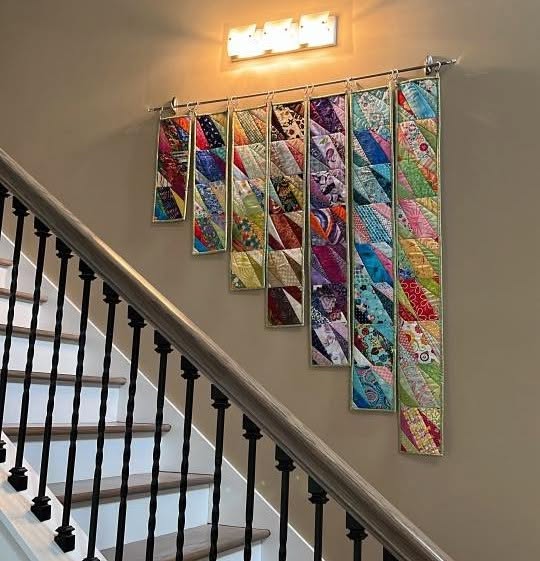
The wall hanging shown consists of several long panels.
Each panel is approximately:
- 6–8 inches wide
- different lengths
The panels hang independently from a decorative rod.
This creates movement and gives the illusion of a cascading waterfall.
Materials
Fabric
Use quilting cotton scraps.
The more variety, the better.
Collect fabrics including:
- Florals
- Batiks
- Polka dots
- Stripes
- Solids
- Tone-on-tone prints
- Modern prints
- Novelty prints
String Width
Cut strips ranging between:
¾”
and
2″
Wide variation creates a more interesting composition.
Background Foundation
Choose one:
- Muslin
- Lightweight cotton
- Foundation fabric
- Wash-away foundation
- Paper foundation (optional)
Most quilters prefer muslin because it remains inside the quilt.
Batting
Thin cotton batting
or
80/20 cotton/poly blend
Backing Fabric
One coordinating fabric large enough for each panel.
Binding
2½-inch binding strips.
Tools
- Rotary cutter
- Acrylic ruler
- Cutting mat
- Sewing machine
- Walking foot
- Quarter-inch foot
- Steam iron
- Pins or clips
- Fabric scissors
- Thread
Cutting the Strings
Unlike traditional patchwork, perfection is unnecessary.
Cut strips:
Width:
¾”–2″
Length:
Any length longer than your panel width.
Do not worry if some strips are short.
They can be joined before sewing.
Preparing the Foundation
Cut muslin rectangles.
Example:
8″ × 30″
8″ × 36″
8″ × 42″
8″ × 48″
Each rectangle becomes one hanging panel.
Leave extra fabric around the edges for trimming later.
Choosing Colors
The photograph uses a balanced rainbow palette.
Notice that:
Every panel contains:
- warm colors
- cool colors
- lights
- mediums
- darks
Avoid grouping all similar colors together.
Scatter them randomly.
Beginning the Panel
Place your first strip diagonally across the foundation.
The strip should run from one corner toward the opposite corner.
Do not place it horizontally or vertically.
Diagonal placement creates movement.
Adding the Second Strip
Take another strip.
Place it:
Right Sides Together
along one edge of the first strip.
Sew using a ¼-inch seam.
Flip it open.
Press.
Continue Building
Add another strip to the opposite side.
Sew.
Flip.
Press.
Continue alternating sides until the entire foundation is covered.
Some strips may extend beyond the foundation.
That is completely normal.
Mixing Prints
Professional quilters avoid placing:
Two identical prints together.
Two large florals together.
Too many dark fabrics in one area.
Instead, alternate:
Large print
Small print
Solid
Busy print
Light
Dark
Repeat.
Pressing
Press after every seam.
Lift the iron instead of sliding it.
Sliding can distort the diagonal strips.
Covering the Entire Foundation
Continue until every corner of the foundation is completely covered.
No foundation should remain visible.
Trimming
Turn the panel over.
Using the foundation as a guide,
trim away all excess fabric.
Your panel now has perfectly straight edges.
Making Multiple Panels
Repeat the process for each hanging panel.
The project in the photograph uses several panels of different lengths to create a cascading effect.
Example:
- Panel 1 — 18″
- Panel 2 — 24″
- Panel 3 — 30″
- Panel 4 — 36″
- Panel 5 — 42″
- Panel 6 — 48″
- Panel 7 — 54″
You can adjust these dimensions to fit your wall space.
Layering
For each panel:
Backing (wrong side up)
↓
Batting
↓
Pieced panel (right side up)
This creates the Quilt Sandwich.
Basting
Secure the layers with:
Safety pins
or
Basting spray
Quilting
The panels in the photograph appear to be quilted with straight-line diagonal quilting, following the direction of the string strips.
This is one of the easiest and most effective ways to quilt string piecing.
Using a walking foot:
Sew quilting lines approximately ½” to 1″ apart, keeping them parallel to the diagonal strips. This reinforces the design and adds texture without distracting from the colorful patchwork.
Binding
Trim each quilted panel.
Attach double-fold binding.
Miter all four corners.
Hand-finish or machine-finish the binding.
Hanging Sleeve
Cut a strip:
Approximately:
4″
wide
Length:
Equal to the finished width of each panel.
Fold lengthwise.
Sew into a tube.
Attach it to the back near the top edge.
The hanging rod passes through this sleeve, hiding the support from the front.
Hanging Hardware
The example in your photo uses:
- A decorative metal curtain rod
- Individual curtain rings with clips
Each finished panel is clipped separately, allowing them to hang at different heights. This creates the elegant cascading effect without sewing the panels together.
Professional Tips
- Keep your diagonal angle consistent across all panels (about 45°) for a cohesive look.
- Mix strip widths intentionally—very narrow strips add detail, while wider strips give the eye a place to rest.
- Include a few neutral fabrics to prevent the composition from becoming visually overwhelming.
- Press after every seam to keep the foundation flat and avoid distortion.
- Make the longest panel first, then use leftover strings for the shorter panels to reduce waste.
- Before hanging, arrange the panels on the floor and experiment with different lengths and color placement until the overall composition feels balanced.
- This project is an excellent way to use very small fabric scraps that are too narrow for traditional patchwork but still too beautiful to discard.